
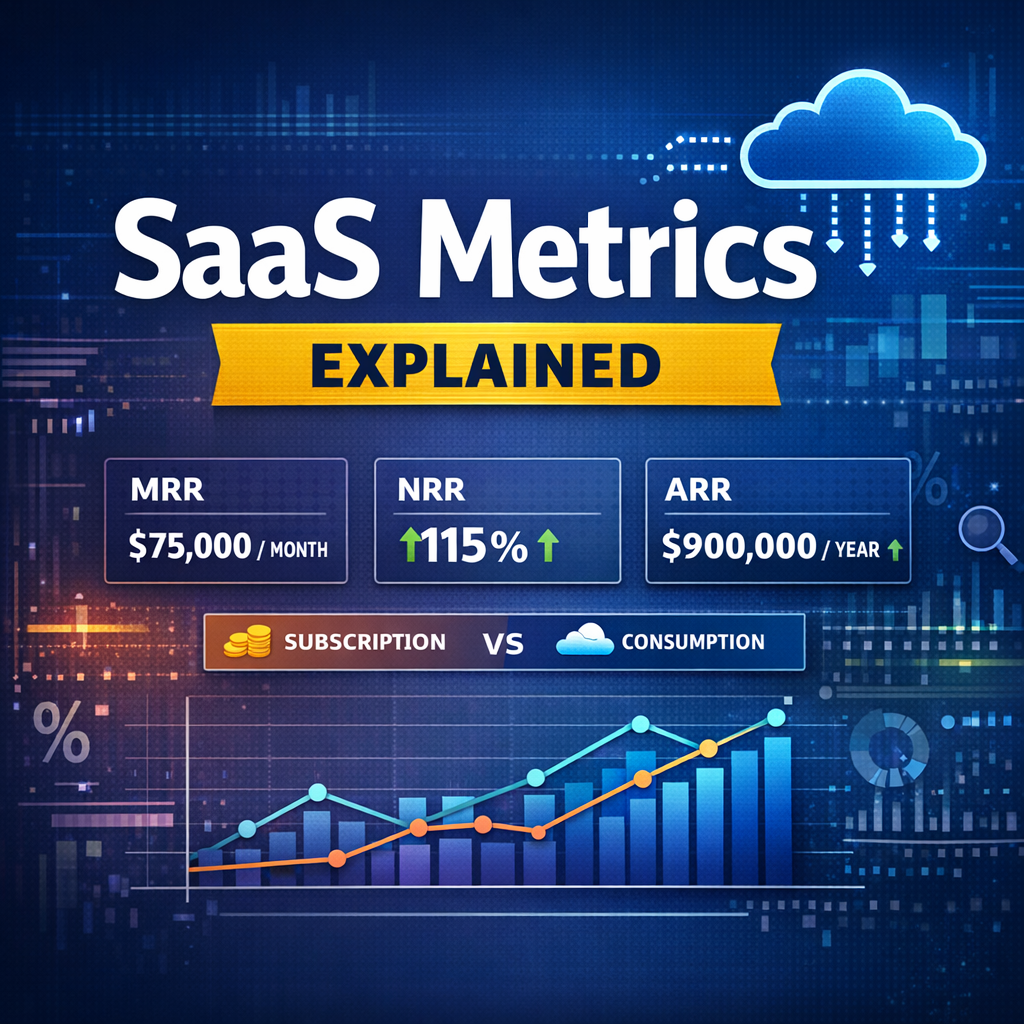
# SaaS Metrics Explained (With Consumption-Based Model Examples)
In the SaaS world, growth is not just about acquiring customers — it’s about **retention, expansion, efficiency, and predictable revenue**.
Whether you operate a subscription SaaS or a consumption-based company, understanding core SaaS metrics is critical for:
* Revenue forecasting
* Investor reporting
* Sales compensation planning
* Product growth strategy
* RevOps decision-making
In this article, I’ll break down the **most important SaaS metrics**, how to calculate them, and how they differ in a **consumption-based model**.
—
## 1️⃣ Monthly Recurring Revenue (MRR)
### 📌 What is MRR?
Monthly Recurring Revenue is the predictable monthly revenue from subscriptions.
### 📊 Formula:
“`
MRR = Sum of all monthly subscription revenue
“`
### Example (Subscription SaaS)
* 100 customers paying $500/month
* MRR = 100 × 500 = **$50,000**
### ⚠️ In a Consumption-Based Model
Companies like **Snowflake** do not rely on fixed subscriptions. Revenue depends on actual usage (compute credits consumed).
Instead of fixed MRR:
* Revenue fluctuates monthly
* Finance teams estimate **Committed MRR** or **Expected Usage Revenue**
👉 RevOps teams must forecast usage trends, not just contract value.
—
## 2️⃣ Annual Recurring Revenue (ARR)
### 📌 What is ARR?
ARR = MRR × 12
If MRR = $50,000
ARR = $600,000
### 💡 In Consumption SaaS
ARR is often based on:
* Contracted minimum commitment
* Historical usage trends
* Expansion patterns
For example:
A customer commits to $100K annually but consumes $140K.
ARR may reflect committed value, while actual revenue reflects consumption.
This creates **upside expansion revenue**.
—
## 3️⃣ Net Revenue Retention (NRR)
NRR is one of the most important SaaS metrics.
### 📊 Formula:
“`
NRR = (Starting Revenue + Expansion – Contraction – Churn) / Starting Revenue
“`
### Example:
* Starting revenue = $1,000,000
* Expansion = $200,000
* Contraction = $50,000
* Churn = $100,000
NRR = (1,000,000 + 200,000 – 50,000 – 100,000) / 1,000,000
NRR = 105%
### 💡 Why It Matters
* NRR > 100% means you grow without acquiring new customers.
* Elite SaaS companies maintain 120%+ NRR.
### 🚀 Consumption Model Advantage
Usage-based companies like **Datadog** and **Snowflake** often achieve high NRR because:
* Customers naturally expand usage over time
* No heavy upsell friction
* Growth is tied to customer success
This is why investors love consumption models.
—
## 4️⃣ Customer Acquisition Cost (CAC)
### 📊 Formula:
“`
CAC = Total Sales & Marketing Cost / New Customers Acquired
“`
Example:
* Sales + Marketing = $500,000
* 50 new customers
CAC = $10,000 per customer
### 💡 In Consumption Model
CAC becomes riskier because:
* Revenue is not guaranteed monthly
* Customers may under-consume
That’s why companies track:
👉 CAC Payback Period
👉 Expansion Revenue Rate
—
## 5️⃣ CAC Payback Period
### 📊 Formula:
“`
CAC Payback = CAC / Gross Margin per Customer per Month
“`
Example:
* CAC = $10,000
* Monthly Gross Margin = $2,000
Payback = 5 months
Shorter payback = healthier SaaS company.
—
## 6️⃣ Gross Margin
### 📊 Formula:
“`
Gross Margin = (Revenue – Cost of Service) / Revenue
“`
Example:
* Revenue = $1,000,000
* Cloud Infrastructure Cost = $300,000
Gross Margin = 70%
### 💡 Why It’s Critical in Consumption SaaS
Consumption companies rely heavily on cloud infrastructure.
For example:
* Compute-heavy companies using AWS/GCP/Azure must carefully manage cost per credit.
* Poor infrastructure optimization can destroy margins.
—
## 7️⃣ Rule of 40
Investors use this to evaluate SaaS health.
### 📊 Formula:
“`
Growth Rate + Profit Margin = ≥ 40%
“`
Example:
* Revenue growth = 30%
* Profit margin = 15%
Total = 45% ✅
Consumption companies often trade profitability for high NRR-driven growth.
—
## 8️⃣ Burn Multiple
Important in today’s capital-efficient SaaS world.
### 📊 Formula:
“`
Burn Multiple = Net Burn / Net New ARR
“`
Lower is better (<1.5 is strong).
—
# Subscription vs Consumption Model: Key Differences
| Metric | Subscription SaaS | Consumption SaaS |
| ———————- | —————– | —————– |
| Revenue Predictability | High | Moderate |
| Expansion Motion | Sales-driven | Usage-driven |
| NRR | 100–115% | 110–140% |
| Forecasting | Contract-based | Usage trend-based |
| Risk | Churn | Under-consumption |
—
# Why These Metrics Matter for RevOps
As Revenue Operations leaders, these metrics help you:
* Design comp plans
* Forecast revenue accurately
* Prevent revenue leakage
* Align product usage with revenue
* Improve quote-to-cash processes
In consumption models especially, **product analytics becomes revenue analytics**.
—
# Final Thoughts
The future of SaaS is shifting toward:
* Hybrid pricing (subscription + consumption)
* Usage-based billing
* AI-driven expansion
* Customer-led growth
Companies like **Snowflake** and **Datadog** prove that when customers win, revenue scales naturally.
If you work in Revenue Cloud, CPQ, or Quote-to-Cash, understanding these SaaS metrics is no longer optional — it’s foundational.
Leave a Reply